

If you were watching Game 1 and Game 2 of the QMJHL Final you no doubt noticed some solid calls, some borderline ones and probably some that left you shaking your head. and Right or wrong that happens a lot in the playoffs. There’s no question both teams will have to control their emotions and stay discipline as the series shifts to Chicoutimi. There’s a sense or one could assume after what we have seen that Game 3 and Game 4 will be called tighter.
There’s been a lot of attention and press around numerous calls throughout the entire Q playoffs, and that all comes back to standard. Clearly any league or governing body take a lot of pride in setting and reinforcing the standard set or established, but that all comes back to consistency this time of year. The “let them play” mentality and mantra in the playoffs definitely adds to the intrigue, excitement allure of this time of year, but one can only hope that doesn’t deviate from the standard and the consistency of it.
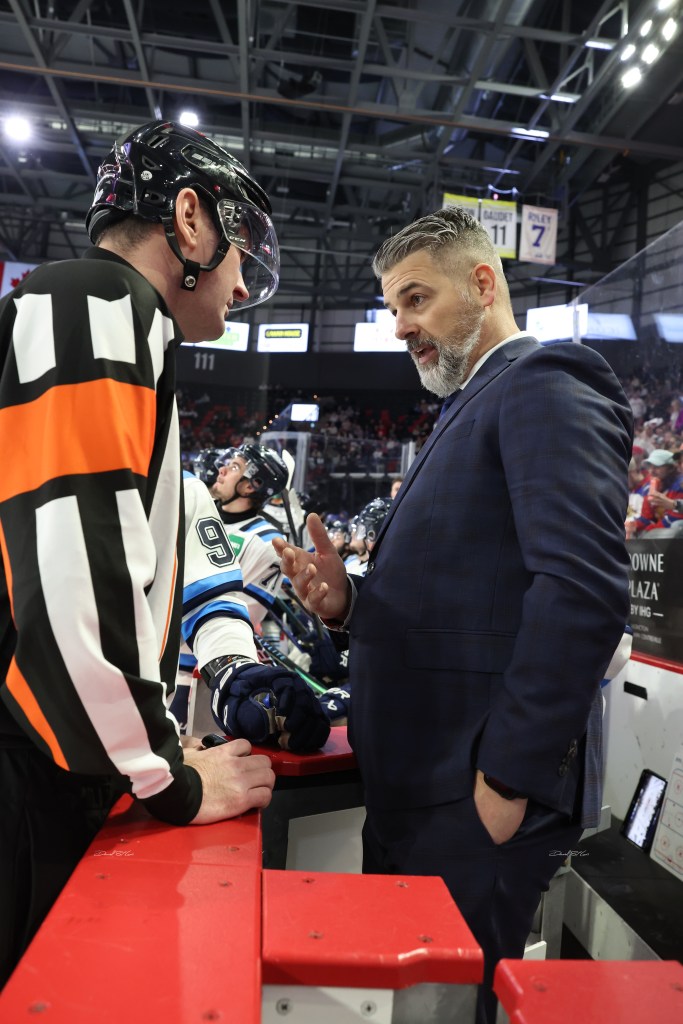
Obviously, there’s no love loss between the Moncton Wildcats and Chicoutimi Sagueneens and if the first two games are any indication this going to be one of those classic series to watch, but things could drastically change if a subsequent march to the penalty box occurs.
Will the standard set in Game 1 and 2 change heading into Game 3 and 4? Clearly that remains to be seen, but there’s no question both teams have the ability to break things wide open on the man advantage. Both the Cats and Sags are known for taking a lot of penalties, both are great at killing them off and both have been much approved in the discipline department throughout the post season. One would also assume on the big ice that more stick infractions could occur, and it’s been evident that some “would be” stick infractions have been slightly overlooked in the playoffs.
So, what is the standard when it comes to the QMJHL in the regular season and does that standard change in the post season and if it does why?
When “the standard” is brought up in the playoffs, one might assume “the OT” standard comes into play, i.e. Did the subsequent infraction take away or eliminate a possible scoring chance? One could also make the assumption that’s why officials are a split second delayed with their assessment of the possible infraction to determine if in fact it eliminated a possible scoring chance or key possession or scenario. Those in the media or in the press box have the luxury of the replay or video, refs have their instincts and a split second on the ice to get it right. Of course the refs also have video replay to make sure things are right which is great at the end of the day. Every game whether it’s in the playoffs or regular season is it’s own entity. Ultimately, whether people like to hear it or not, “the standard” is somewhat open to interpretation and potentially malleable. That’s not a criticism of the officials or league standards; that’s potentially just the way it is. In saying that perhaps that’s why coaches and players become confused or highly agitated because of the ever-changing standard.
Is a hook in November, a hook in April?
Is a slash in December, a slash in May?
Well, I guess that depends on the interpretation of the officials calling that particular game and the standard that they have set in place. Fundamentally the standard should be consistent and for the vast majority of the year it potentially is, however, is there an unwritten rule that “the standard” changes in the playoffs?
Everything gets amplified and intensifies in the playoffs and that’s why the QMJHL or any league for that matter select their best officials to be out there this time of year. All eyes are on the Moncton Wildcats and Chicoutimi Sagueneens, but there’s even more eyes and scrunity on the stripes patrolling the ice in the postseason.
The standard as been set, but will it change in Game 3 and 4? Time will tell!

