

There’s more questions than answers right now with regards to what the hockey world wants to see in a defenceman. Can they skate? Can they think the game? Can they defend? Can they pass the puck? Can they bring offence?

Those are the five questions scouts no doubt ask when evaluating and projecting any young defender, but what about how? How well do they skate? How well do they think or process the game? How effectively and efficiently do they pass the puck? How often do they bring offence? How do they defend? Can they do it all? That’s what everyone wants to see when it comes to the defencemen in the game today.
It’s the “how,” that should be the most intriguing in this day and age, especially with so much individual skill in the game. The demanding role of defencemen is ever changing, but how they defend in “today’s game” is no doubt the most important aspect that still exists.
Higher Learning
When people set out to acquire a degree, they understand that it’s a journey, a process that will take a set amount of time, effort and experience in which to gain a mastery of the curriculum to earn a degree.
Paul Boutilier created 44 Seconds, an In-Season Defensive Development Program that helps defencemen across the hockey world navigate all aspects of the position and the game. Boutilier’s students are driven to succeed and to enhance their knowledge and reach their full potential while earning a “Degree in Defence” from the program.
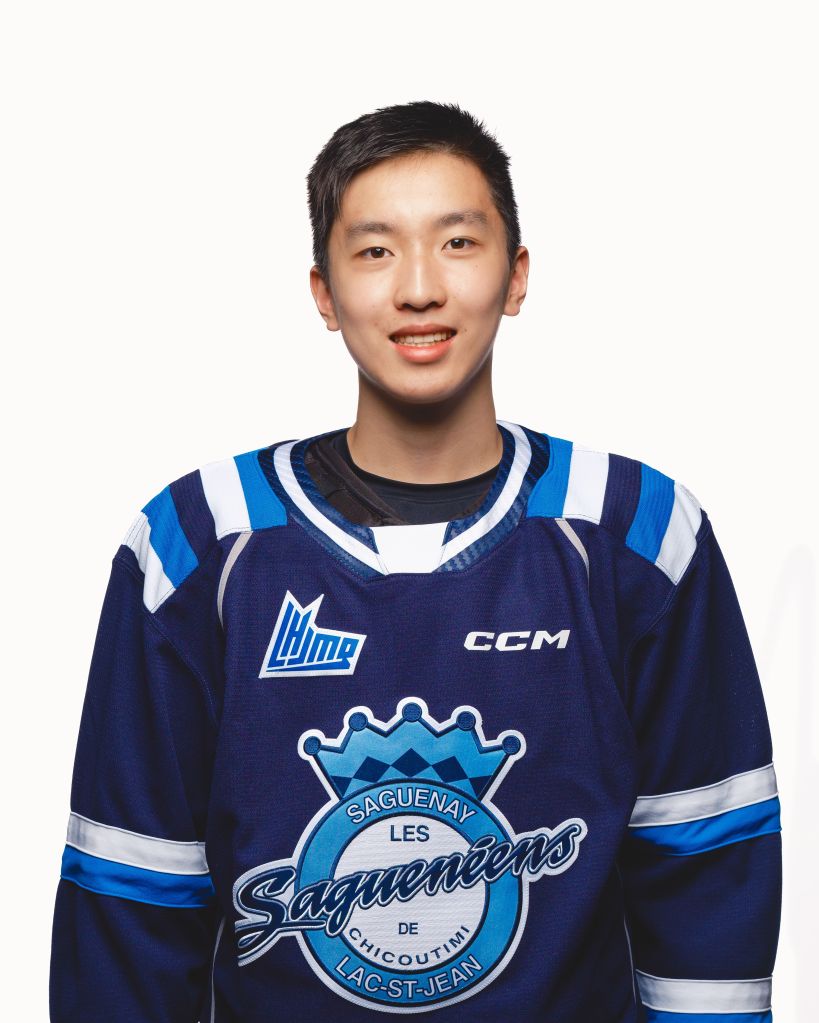
Alex Huang of the Chicoutimi Sagueneens and Will Reynolds of the Acadie-Bathurst Titan are two of the youngest students within the 44 Seconds program who call the QMJHL home. Huang and Reynolds are finding their way and gaining traction within the Q using the fundamental pillars of the educational framework of the program.
One of those pillars is posture.
“Boots emphasizes a lot of things when it comes to posture,” said Huang.
“Having a great posture has many benefits, you can take info of the whole ice and make better scans. You will be less vulnerable to be beat by a skilled player and you will look much taller when others are looking from the stands,” explained Huang.
“Boots is very detailed in situations, he strongly identifies posture as a big aspect for defenders in which I did not realize my posture until Boots brought it to my attention,” said Reynolds who was originally drafted by the Rouyn Noranda Huskies but was traded to the Titan during the 2024 QMJHL Trade Period.
“Posture is about being big, playing big instead of being bent over and not using all of your size in which I was not using,” stressed Reynolds.
Such a simplistic perspective to observe, but one of monumental importance when defending against speed and skill. “The first concept that is taught is back angle and it will help the player not overreach,” said Huang referring to great posture. When defending, a player should skate backwards like if he was sitting on a chair. When a player overreaches, he will likely get beat so maintaining a good posture will help you be at the right spot,” added Huang.
“The second aspect is feet width, which will affect your back angle and your posture in general. The ideal feet width is shoulder width, anything wider will create a bad back angle and a bad posture. Third, the hand/stick placement and where the eyes are looking are also important factors when it comes to posture. Your stick shouldn’t be completely out so you avoid overarching,” explained Huang.
“Your eyes should rarely look at the puck, it doesn’t tell you anything,” stressed Huang who was selected by the Sags 5th overall in last year’s entry draft.
“When playing a 1 on1 the eyes should be up, it’s very important as a defenceman where the eyes should be looking. Your eyes should never be down looking at the puck, the program emphasizes how it makes it easier for forwards to take you off balance and blow by you. Instead of looking at the body/ chest to follow the players movement to take him and makes defending easier by looking up rather than down,” said Reynolds.

Over the last three to four decades or perhaps even longer, the concept of playing a 1 on 1 has certainly deviated. Identifying and being fixated on the sternum was widely taught and reinforced, the “eyes up” approach stressed by 44 Seconds is a difference maker and turns the tables for those defending against the speed and skill that is so prevalent in the game today.
There has been so much emphasis on the highly skilled puck moving defencemen these days, that young draft eligible defenders and defencemen throughout every level in the game have a preconceived notion that they have to be totally committed offensively to get noticed, appreciated and in many cases drafted and play at the next level. That’s simply not the case. The need for well-rounded and complete defencemen is more valuable now than ever before. With so many different coaching philosophies revolving around defending young defencemen coming through the ranks are confused and less confident in their abilities.
The “You Have to Play Them” mindset is another pillar within the 44 Seconds program.
“The eyes tell you everything.”
“Eyes to eyes,” the chest tells you zero, the puck tells you zero, the eyes tell you everything,” said Boutilier.
When young defenders try to defend using other methodology the outcome is less than desirable. That’s when defencemen are caught on the heels, backing up and allowing the forwards to play them rather than the other way around. “As a young junior hockey player that is taking his first steps in the QMJHL, there are many aspects that I am working on that will help me succeed in the short term but more importantly in the long term,” said Huang.
On the Job Training
On the job training or experiencing a practicum is the key to any great degree. That experience will not strengthen the knowledge base, but those experience will only deepen their passion. Huang and Reynolds’ “on the job training” is pressure packed, but that’s life as a 16 year old defender in the QMJHL.
The Q isn’t kind to young defenders, but the “you have to play them” mindset has been in full effect this season. Like any degree, it takes time. Huang and Reynolds have learned a lot on and off the ice this season which will only strengthen their knowledge and understanding of the position and the game. Huang and Reynolds are quick to serve up advice in effort to help other young defenders find their way to the next level and beyond. “With reference to giving advice to younger defenceman out there, I would have to say keep working on your skating. Skating is probably one of my strengths and has helped me get to this level. A strong skater can always improve their game in key areas like gap control and posture,” said Reynolds.
“As a Dman my goal was always to be that player coaches relied on to play in crucial situations of the games. My offensive game has improved a lot over the years, but I have always concentrated more on being very reliable player in my own zone,” added Reynolds.
“As far as my personal advice, I feel like the most important thing for D-men is skating. It is key to have this ability because it is linked to every other skill. You can go to public skating, book sessions with power skating coaches, or even practice it at the outdoor rink,” said Huang.
“Skating has to become an asset for you because it is a transferable skill that many teams are looking for. Skating will buy you many opportunities to succeed, you also have to build yourself an identity.”
“There are a lot of D-men that are big, that can skate and shoot. What is the thing that will separate you from the others? For me, it is my skating, vision and playmaking/improvisation abilities,” stressed Huang.
“Remember that you want this identity to be transferable to the next level. There may be people that doubt that your skill set will work at the next level but believe in yourself.”
“Lastly, always have the mindset that you can improve everyday. Go on the ice as much as your body allows you to work out often and watch film. There’s always room for improvement and if you keep up your work ethic, you will eventually surpass the ones ahead of you,” said Huang.
Over the next four years as Alex Huang and Will Reynolds study to attain their “Undergraduate Level,” program membership offers the unique and rare opportunity to learn from others working to attain their “Masters Level” in the 44 Second Defence Program at the NHL level. Their unique opportunity to review edited teaching video of a Noah Dobson working on his mastery of similar defensive fundamentals such as POSTURE, along with early exposure to program advanced topics at such as game management and retrieval scans critical at the professional level. Unquestionably, Dobson’s development path is on track to be handed his “Master’s Degree” with talk of his prowess as a candidate for a Norris Trophy!
Reynolds and Huang know very early the end game, but to be adept at any profession, it takes time along with a proven curriculum to study from.
“YOU PLAY THEM”
 The Quick Shift